

In the modern era of globalised finance, transparency is the cornerstone of trust. Whether you are a small business owner, a director of a multinational corporation, or a fund manager, you have likely encountered the term Legal Entity Identifier (LEI). As regulatory frameworks tighten across the United Kingdom, the European Union, and the United States, the LEI has transitioned from a niche requirement to a fundamental component of international business identity.
If you are asking how to get a Legal Entity Identifier, this guide provides a detailed, step-by-step walkthrough of the application process, the regulatory necessity behind the code, and how to maintain compliance within the Global LEI System (GLEIS).
What is a Legal Entity Identifier (LEI)?
Before diving into the registration process, it is essential to understand what an LEI actually is. An LEI is a unique 20-character alphanumeric code based on the ISO 17442 standard. It serves as a global “business identity card,” allowing regulators, financial institutions, and counterparties to identify distinct legal entities participating in financial transactions.
The system was developed by the Financial Stability Board (FSB) and is overseen by the Global Legal Entity Identifier Foundation (GLEIF). The goal is simple: to create a transparent environment where every entity, be it a company, a trust, or a fund, can be identified unambiguously across jurisdictions.
The Anatomy of an LEI Code
The code itself contains no embedded information about the country or entity but links to a high-quality, publicly accessible database. This database provides two levels of data:
- Level 1 Data: “Who is who?” This includes the legal name, registered address, and country of formation.
- Level 2 Data: “Who owns whom?” This identifies parental relationships, helping to map out complex corporate structures.
Who Needs an LEI Number?

The requirement for an LEI is driven largely by financial regulations designed to prevent money laundering (AML) and improve market oversight. If your entity is involved in financial transactions, you likely need one.
1. Financial Institutions and Regulated Entities
Banks, investment firms, insurance companies, and asset managers are required to have an LEI to report their trades to authorities. Under regulations like MiFID II and EMIR in Europe, firms cannot execute trades on behalf of a client if that client does not have a valid LEI. This is often referred to as “No LEI, No Trade.”
2. Funds, Trusts, and Charities
It is a common misconception that only “companies” need an LEI. In reality, any entity recognised by law can and often must obtain one. This includes:
- Pension funds
- Hedge funds and private equity vehicles
- Charitable organisations
- Family trusts and sovereign wealth funds
3. Non-Financial Corporations
Even if your primary business is not in finance, you may need an LEI if you enter into derivative contracts to hedge currency or interest rate risks. Furthermore, transparency initiatives are leading many companies to adopt LEIs voluntarily to boost their credibility and streamline KYC (Know Your Customer) processes with partners and banks.
How to Get a Legal Entity Identifier: The Step-by-Step Process
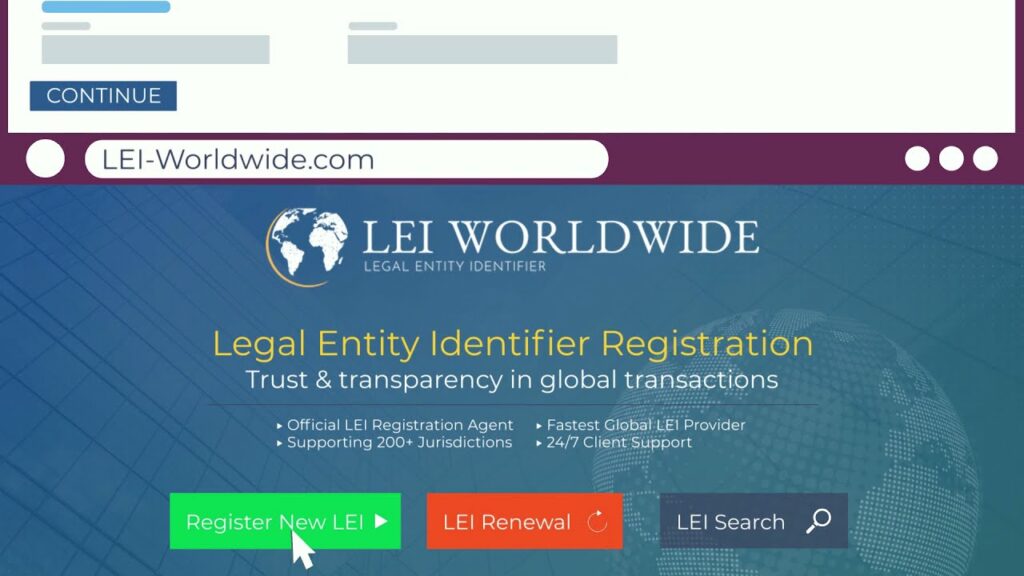
The LEI registration process has been designed to be efficient, typically taking only a few minutes to complete the initial application. You do not need to be a CEO or a director to apply; any authorised representative of the company can manage the application.
Step 1: Choose a Service Provider
You can obtain an LEI through a Local Operating Unit (LOU) or a Registration Agent.
- LOU: These are organizations directly accredited by GLEIF to issue LEIs.
- Registration Agent: These are service providers that streamline the process by acting as an intermediary between the entity and the LOU. They often provide better user interfaces, localized support in English, and multi-year renewal packages.
Step 2: Complete the Application Form
Once you have accessed the registration portal, you will need to provide specific entity details. Accuracy at this stage is vital to avoid delays in validation.
- Legal Name: The official name as registered with your local authority (e.g., Companies House in the UK).
- Registered Address: The headquarters or official legal address.
- Registration Number: The number assigned to you by the national business registry.
- Authority: The specific registry where the entity is listed (e.g., the SEC in the United States or the Registrar of Companies in India).
Step 3: Reporting Parental Information (Level 2 Data)
This section asks if your entity is owned by another legal entity. To report a “Parent,” the parent company must own more than 50% of the entity and consolidate its financial statements.
- If you have a parent company, you will be asked to provide evidence, such as consolidated accounts or an annual report.
- If you do not have a parent, or if you are not allowed to disclose it, you may select a “reporting exception.”
Step 4: Supporting Documentation
The Local Operating Unit must verify the information you provide against official sources. In many cases, the LOU can find your details automatically via an API link to the national registry. However, if your entity is a trust or a new company not yet indexed, you may need to upload documents such as:
- Certificate of Incumbency
- Articles of Association
- Trust Deed
- Register of Directors
Step 5: Payment and Verification
After submitting the form, you must process the payment. Prices vary depending on whether you are registering a new code or renewing an old one. Once paid, the Registration Agent or LOU begins the data quality check.
Step 6: Issuance and Indexing
Once the data is validated, your unique LEI code is generated. You will receive an email confirmation, and your entity will be added to the Global LEI Index. This database is public, allowing any market participant or regulator to verify your identity.
Managing Your LEI: Renewals and Updates
An LEI is not a “one-and-done” registration. To ensure the data quality of the global system, LEIs must be renewed annually.
The Importance of Annual Renewal
An LEI has a “LAPSED” status if it is not renewed by its expiry date. A lapsed LEI can lead to:
- Transaction Failures: Many banks will block trades if they see a lapsed status in the system.
- Regulatory Fines: Non-compliance with reporting obligations like SFTR or CSDR can result in significant penalties.
- Loss of Trust: Partners using the LEI for KYC may view a lapsed status as a lack of corporate diligence.
Multi-Year Renewals
Many registration agents offer 3-year or 5-year plans. In these cases, the agent handles the annual re-validation for you, saving time and ensuring your code remains “ISSUED” and active without manual intervention every twelve months.
The Benefits of Having an LEI
While many see the LEI as a regulatory burden, there are significant business advantages to maintaining a valid identifier.
1. Enhanced Transparency and Credibility
By appearing in the Global LEI Index, your business demonstrates a commitment to transparency. This “digital certificate” proves that your company is a legitimate legal entity, which is particularly useful when dealing with international partners in jurisdictions like Japan or China where local documentation might be hard to verify.
2. Streamlined Onboarding
Banks and financial institutions use the LEI to speed up the KYC and AML checks. Instead of sending dozens of PDFs and registry extracts, you can simply provide your LEI. The bank can then pull all necessary data from the GLEIF database, significantly reducing the time it takes to open accounts or secure loans.
3. Preparedness for Future Technology
The global financial system is moving toward automation. The LEI is already being integrated into blockchain technology, smart contracts, and Artificial Intelligence (AI) driven risk assessment tools. Having an LEI ensures your business is “digitally ready” for the next wave of fintech innovation.
Common Questions Regarding LEI Registration
How long does it take to get an LEI?
The timeframe varies depending on the entity type and the country. For a standard UK or US company, issuance often happens within a few hours. For complex structures like trusts or entities in jurisdictions with manual registries, it can take 24 to 48 hours.
Can an individual get an LEI?
Generally, no. The LEI is for legal entities, not individuals. However, a “Sole Trader” may be eligible to obtain an LEI if they are acting in a business capacity and are required to do so by a financial institution for reporting purposes.
Is an LEI the same as a VAT number?
No. A VAT number is for tax purposes within a specific jurisdiction. An LEI is a global identifier for financial transactions and corporate identity.
What happens if my company details change?
If your company changes its name, moves its registered office, or undergoes a merger, you must update your LEI record. You can do this by contacting your Registration Agent or LOU. Keeping this information current is part of the data quality standard required by GLEIF.
The Role of the Global LEI System (GLEIS)
The GLEIS is a unique public-private partnership. The Regulatory Oversight Committee (ROC), consisting of authorities from around the world, ensures that the system serves the public interest. This structure ensures that no single private entity “owns” the data, keeping it as a public good that promotes global financial stability.
By obtaining an LEI, your company becomes a part of this global network. You contribute to a system that reduces risks, prevents market abuse, and provides a clear map of financial interconnections.
Conclusion: Take Action Today
Securing a Legal Entity Identifier is a straightforward but essential task for any modern business. It ensures you remain compliant with global regulations, protects your ability to trade in the financial markets, and provides an internationally recognised mark of legitimacy.
Are you ready to register?
The process is simple:
- Gather your details: Name, address, and registration number.
- Submit your application: Use a trusted Registration Agent to guide you through the form.
- Stay compliant: Opt for multi-year renewals to avoid the risk of a lapsed status.
Don’t let a missing or lapsed identifier interrupt your business operations. Whether you are operating in the United States, Europe, or Asia, the LEI is your key to the global marketplace.
Contact and Support
If you have further questions or need assistance with a bulk application for multiple funds or subsidiaries, our team is here to help. Contact us at support@lei-worldwide.com or visit our blog for the latest updates on global financial regulations and LEI requirements.