

Last updated: August 2026
In this article
What was the GMEI Utility? What happened in 2023 What it looked like from the inside How to check who manages your LEI now Renewing an LEI transferred from GMEI Frequently asked questionsThe GMEI Utility recently closed its doors as one of the largest, and first, Local Operating Units (LOUs), the organisations that issue LEIs. If your LEI was issued by GMEI Utility, don't worry, it still exists and it still works (maybe). It could, however, have expired, and that can cause serious issues. The organisation that issued it no longer does, and that's the source of most of the confusion that still lands in our support inbox three years on.
Here is what happened, what it means for your LEI, and what to do about it.
What was the GMEI Utility?
The GMEI Utility was DTCC's LEI issuing service, run through its subsidiary Business Entity Data B.V. It was one of the earliest and by far the largest LEI issuers in the system: it issued LEIs across more than 140 jurisdictions and, at its peak, was responsible for roughly half of all LEIs in existence worldwide, almost half a million LEIs.
That scale presented a difficulty when it closed. Half a million entities required LEIs for regulatory purposes and relied on a platform to manage them, so the real challenge was relocating those LEIs across other providers in an organised, clear and well-communicated way. Generally, companies self-manage their LEIs, and people change roles, leaving the LEI unattended. When GMEI shut down, LEIs got lost, essentially.
What happened in 2023
DTCC's stated reason was strategic, not operational. In its own shutdown FAQ it explained that "after a thorough assessment of the GMEI business in the context of DTCC's overall business strategy, it was concluded that the GMEI lacked alignment with DTCC's strategic focus." In other words, GMEI was a side business, and DTCC chose to step away from it.
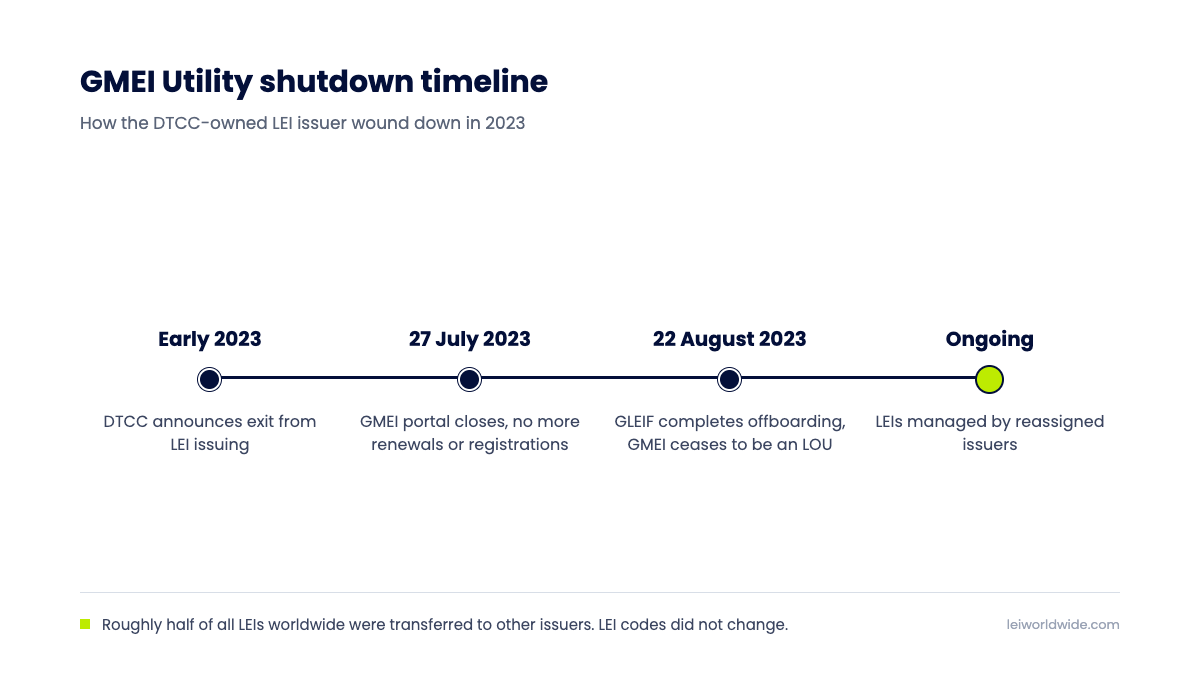
The timeline of events:
27 July 2023, 5pm EDT: the GMEI client portal closed and renewals, challenges and new registrations stopped being accepted.
27 July to 22 August 2023: GLEIF's LEI Management Transfer process ran, with no Transfer Request Form required, the move was automated between GMEI, GLEIF and the receiving issuers.
22 August 2023: the GMEI exit date. GMEI ceased to be an LOU, and every LEI on its books was managed by someone else.
Who received each LEI was not the holder's choice, and not DTCC's either. GLEIF ran the allocation itself, evaluating candidate issuers on "geography and entity type for which LOUs are accredited to provide LEI services, historical Service Level performance, historical Data Quality performance and operational ability to engage in the transfer." DTCC's FAQ is blunt about it: "DTCC/BED B.V. has no discretion over this process."
Source: DTCC, GMEI Exit Rationale and Transfer Process FAQ. DTCC confirmed the exit publicly to FTF News on 15 August 2023.

Two things about that transfer matter, and they are the two things people most often get wrong.
Your LEI code did not change, and it never does. The LEI is immutable. The 20-character code is permanent for the life of the entity, whoever manages it. If your LEI was 5493… before the transfer, it is 5493… now.
Who manages it did change. Renewal reminders, invoices and record updates now come from a different organisation, one you never chose and may never have heard from. That is why so many entities discovered the transfer only when something went wrong.
What it looked like from the inside
Most of the enquiries we took were the same shape: a compliance officer or company secretary who had gone looking for their LEI record, couldn't find it where it used to be, and had no idea who was responsible for it now. The LEI had become an orphaned identifier with nobody to ask about it.
It didn't help that DTCC's FAQ had said, accurately, that clients "will be advised of their new LEI provider." Being advised and being aware turned out to be different things, especially for groups holding dozens of LEIs across several jurisdictions, each potentially landing with a different issuer.
Two real-world examples of this:
WB Asset Management, US
WB, a US investment bank and asset manager, held LEIs across its group that had been issued by GMEI. After the transfer, locating those records and establishing who now managed each one was not straightforward, and it needed to be, because a portfolio of that size can't function without well-managed compliance controls, of which the LEI is one. Our team was able to trace the LEIs by crawling with our internal API tools, confirm their status and current issuer by providing an entity map and report to the company, and bring them under management, handled in-house at no additional cost.
Realty Income
Realty Income, the NYSE-listed REIT, found the problem the hard way, and luckily we were able to offer an urgent workaround. A GMEI-issued LEI had lapsed after the transfer, unnoticed, because the renewal notices from the new issuer never registered with anyone responsible for it. It surfaced when a Euro Commercial Paper trade approached T+2 settlement and the counterparty flagged that the LEI was not active. No active LEI, no settlement.
We identified where the record now sat, reactivated it (which is not always instant when transfers are involved), and the trade settled on time.
"The fact that you stepped in is greatly appreciated at Realty Income."
These are just two cases. A market-wide transfer of half the world's LEIs was absorbed, in the end, one confused email at a time, by support teams and account managers who knew where to look.
How to check who manages your LEI now
Search your LEI on the Global LEI Index. The record shows the current managing LOU, the registration status, and the next renewal date. If the status reads Lapsed, the LEI needs renewing before it can be used for reporting. If you don't recognise the managing LOU, that is almost certainly the post-GMEI transfer, and it's the organisation now sending your renewal notices.
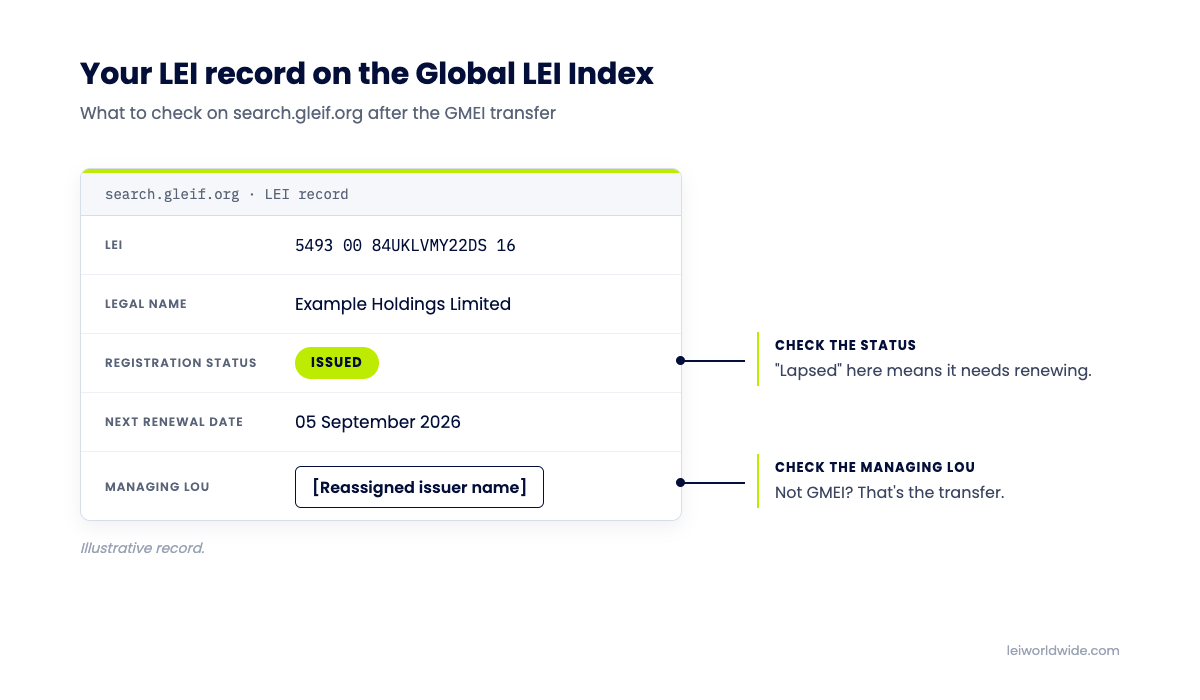
You can do the same check on LEI Search, which shows status and expiry at a glance.
Renewing an LEI transferred from GMEI
You have two options, and neither changes your code.
Renew directly with whichever issuer received your LEI in the transfer. Or transfer it again, this time to a provider you choose. Transfers between accredited providers are free under GLEIF policy, take a few business days, and don't interrupt the LEI's validity. Many former GMEI holders take this route precisely because they never chose their current issuer and want their LEIs consolidated with the rest of their portfolio.
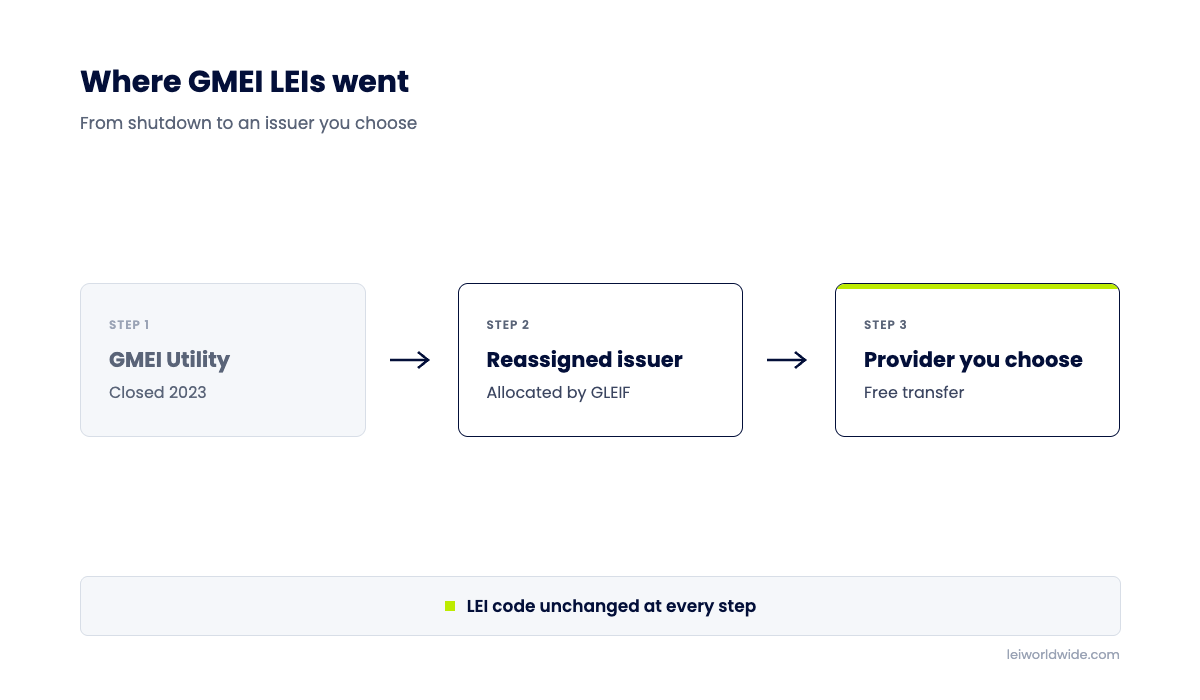
If your LEI has already lapsed, transfer and renewal can be done in one step, which reactivates it.
We renew and transfer former GMEI LEIs routinely. If you'd rather not work out where yours ended up, send us the code and we'll trace it.
Hold a former GMEI LEI?
Start by finding it. Then renew or transfer it, code unchanged, transfer free.
Find my LEI Renew or transfer my LEIFrequently asked questions
Is my GMEI Utility LEI still valid?
Yes, if it has been renewed since the transfer. The code itself is unchanged and permanent. Check the status on the Global LEI Index: Issued means active, Lapsed means it needs renewing.
Who is my LEI issuer now that GMEI has closed?
GLEIF allocated GMEI's LEIs to other accredited issuers by jurisdiction. The current managing LOU is shown on your LEI record on the Global LEI Index.
Did my LEI number change when GMEI Utility shut down?
No. The 20-character LEI code never changes for the life of the entity. Only the organisation responsible for maintaining it changed.
Can I move my former GMEI LEI to a different provider?
Yes. Transfers between accredited providers are free under GLEIF policy and take a few business days. The code stays the same and the LEI remains valid throughout.