


Home › LEI regulations
The LEI is a regulatory instrument before it is anything else. More than 250 regulations, rules and official guidelines worldwide reference the Legal Entity Identifier, making it the most widely used entity identifier in financial regulation. This page lists them, searchable by country and rule, with the newest requirements first. If a bank, broker, regulator or counterparty has asked your entity for an LEI, the rule behind the request is on this page.
The system behind the identifier is regulatory too. The LEI was created on a G20 mandate after the 2008 crisis, when regulators could not reliably identify who was connected to whom. It is overseen by the LEI Regulatory Oversight Committee (LEI ROC), a body of more than 70 public authorities, central banks, securities regulators and finance ministries from over 50 jurisdictions, with GLEIF operating the system under its oversight. When a regulation names the LEI, it is naming an identifier that regulators themselves govern. That is why it keeps appearing in new rules, and why no private or commercial identifier does.
Recently in force
The requirements that changed most recently, and the ones most likely to be behind a new LEI request in 2026.
DORA
Every ICT third-party provider to an EU financial entity must hold an active LEI for the register of information. In force since 17 January 2025; the ESAs' first critical-provider designations followed in November 2025. Read our DORA guide.
FATF Recommendation 16
The revised global payment transparency standard names the LEI as an identifier for legal persons in payment messages. Detail in the focus section below.
MiCA
The EU's crypto-asset framework identifies issuers and crypto-asset service providers by LEI across authorisation, white papers and the Transfer of Funds travel rule.
ELTIF 2.0
The amended European Long-Term Investment Funds Regulation applies since January 2024. ELTIFs are identified by LEI in ESMA's public register and supervisory reporting.
AMLR
The EU's Anti-Money Laundering Regulation embeds the LEI, where available, in customer due diligence from 2027. One to prepare for, not react to.
Who has mandated it
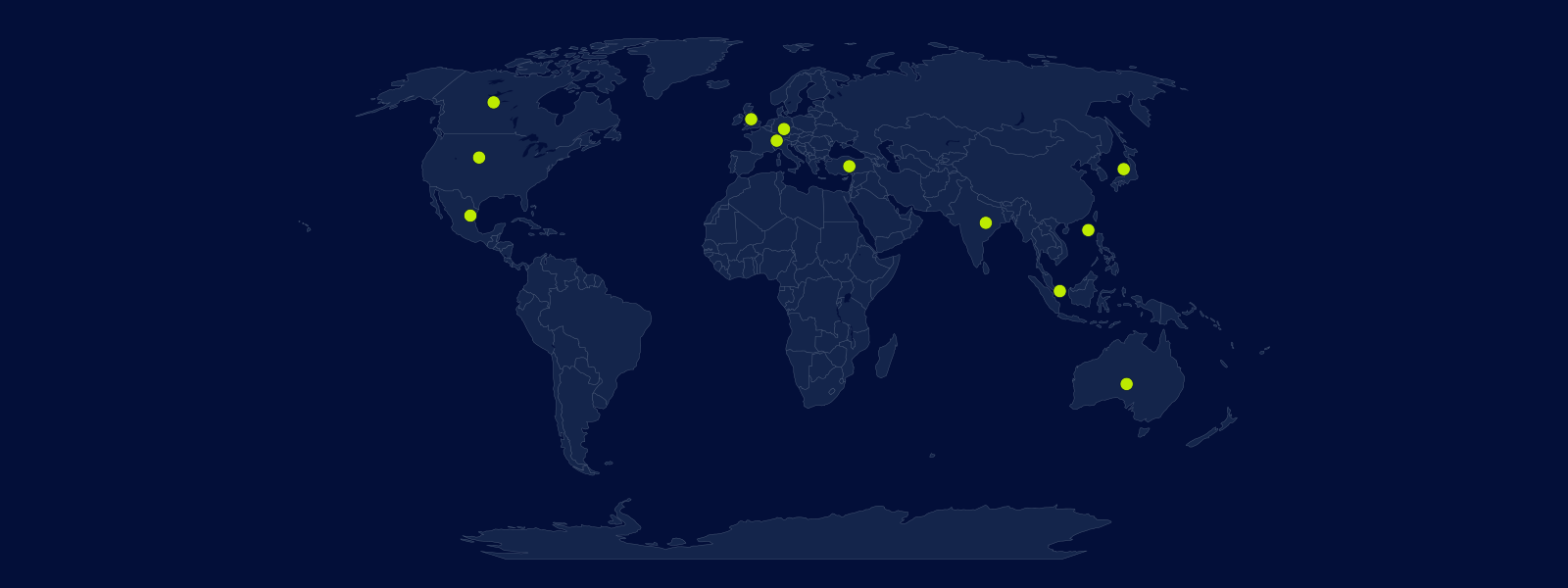
LEI requirements are law in every major financial centre. The European Union and United Kingdom will not let an entity trade reportable instruments without one. The United States requires it across swap, fund and bank reporting. India requires it for large-value payments, borrowing and cross-border transactions. Canada, Switzerland, Hong Kong, Australia, Singapore, Japan, Mexico and Turkey mandate it in transaction reporting.
For jurisdictions without a domestic mandate, the mandate arrives through the counterparty. A Cayman or BVI fund has no local LEI rule, and needs an LEI anyway: the moment it trades with an EU or UK investment firm, MiFIR and EMIR reporting require its identifier before the trade can happen; a US swap dealer needs it under CFTC rules; its EU service providers now need it under DORA. Offshore entities are already inside the system through everyone else's regulations. The only question a financial centre without a mandate faces is whether its entities are identified on its own terms or on its counterparties'.
Focus: FATF Recommendation 16, payments and crypto
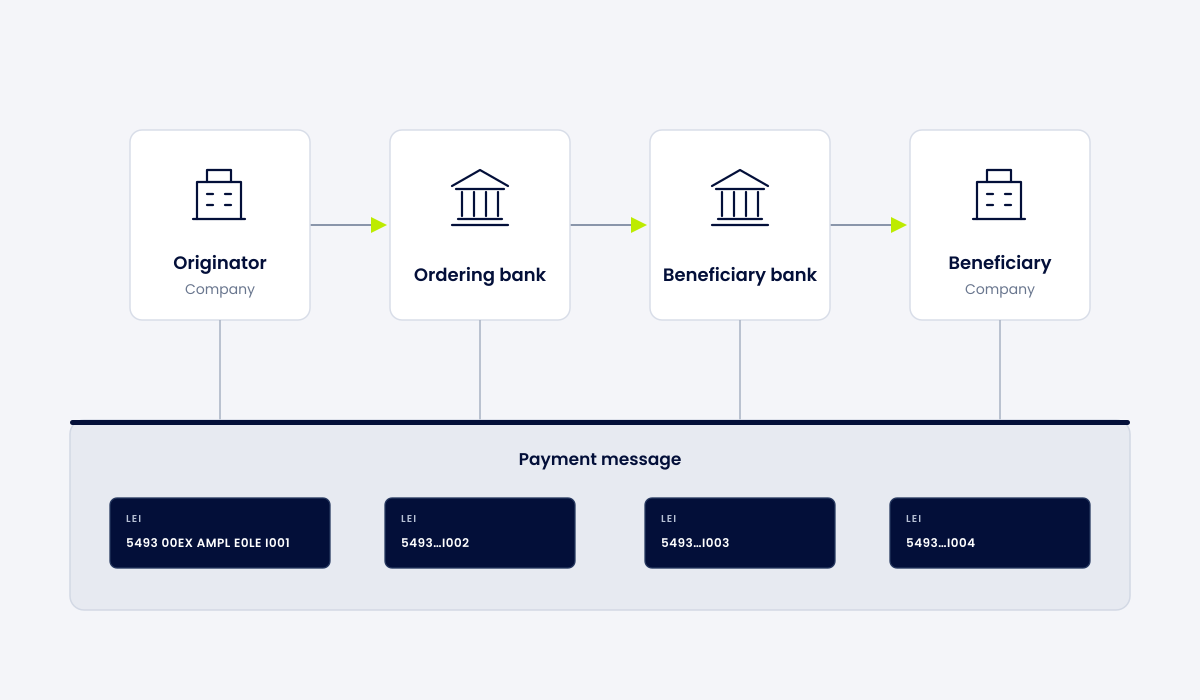
The most consequential recent development for the LEI sits outside any single jurisdiction. In 2025 the Financial Action Task Force adopted a revised Recommendation 16, renamed from "wire transfers" to payment transparency, the global standard behind what the industry calls the travel rule: the requirement that basic originator and beneficiary information travels with every payment.
The revision does something the previous text never did. It distinguishes between people and legal entities, and for legal entities it names the identifiers. The full text sits in the FATF Recommendations (PDF), Recommendation 16 and its Interpretive Note. For qualifying payments, the information accompanying the transfer should include, for a legal person:
"where the originator and/or beneficiary is a legal person, the following information, where this exists: (i) the connected business identifier code (BIC), or (ii) the Legal Entity Identifier (LEI), or (iii) the unique official identifier of the originator and/or beneficiary."
FATF, revised Recommendation 16, Interpretive Note, 2025
The practical meaning: as jurisdictions implement the revised standard, phased alongside the ISO 20022 migration toward 2030, the LEI becomes a recognised way to identify companies inside payment messages themselves, not just in post-trade reports. GLEIF's commentary on the revision describes the LEI as the key identifier for legal persons in qualifying transactions, enabling digital retrieval of a counterparty's verified name and address and precise matching for beneficiary verification, the same mechanism the EU's Instant Payments Regulation permits as an alternative to name-matching in Verification of Payee.
The crypto extension
Recommendation 16 applies to virtual asset service providers through FATF's travel rule guidance, and the same identification logic is arriving in crypto regulation directly. Under the EU's MiCA framework and the recast Transfer of Funds Regulation, crypto-asset service providers are identified by LEI and originator and beneficiary information must accompany crypto transfers. In the United States, the CFTC's Market Risk Advisory Committee recommended in December 2024 that US regulators expand LEI use across reporting regimes, and the 2025 GENIUS Act created a federal framework for payment stablecoin issuers in which reliable issuer identification is a supervisory requirement, the role the LEI already performs in every comparable regime. For a regulated crypto firm the direction is uniform: the entity behind the wallet, the issuance or the service must be identifiable by a standard code, everywhere it operates.
For VASPs and CASPs: run an LEI programme for your clients
Exchanges and crypto-asset service providers onboarding corporate clients under MiCA and travel rule requirements can issue and manage LEIs for those clients through us: bulk registration, renewal management and API integration, run by our team. We already do this for regulated institutions.
Talk to us about a client LEI programmeEvery LEI regulation, searchable
Filter by jurisdiction or search by rule, and click any column heading to sort. Required means the rule cannot be complied with without an LEI. Requested means the LEI is asked for where it exists. Based on the regulatory texts and GLEIF's regulatory-use records; dates are the year the LEI provision took effect.
Why regulators keep choosing it, in ESMA's words on the DORA register of information:
"Identify unambiguously and consistently the ICT third-party service providers and the FEs by using the Legal Entity Identifier (LEI) to enable an efficient aggregation of relevant information"
ESMA, EBA and EIOPA, Final Report on the Register of Information, 2024
| Jurisdiction | Regulation / rule | Where the LEI is used | Status | In force |
|---|---|---|---|---|
| EU | MiFID II / MiFIR transaction reporting | Every reportable trade identifies the parties by LEI. Investment firms cannot execute for an entity client without one: no LEI, no trade. | Required | 2018 |
| EU | EMIR derivatives reporting | Counterparties to every derivative contract reported to trade repositories are identified by LEI. | Required | 2014 |
| EU | SFTR securities financing reporting | Parties to repos, securities lending and margin lending identified by LEI in trade repository reports. | Required | 2020 |
| EU | DORA register of information | Financial entities identify every ICT third-party service provider by an active LEI in the annual register submission. | Required | 2025 |
| EU | MiCA and the recast Transfer of Funds Regulation | Crypto-asset service providers and issuers identified by LEI; originator and beneficiary information accompanies crypto transfers. Phased application 2024 to 2025. | Required | 2024 |
| EU | ELTIF Regulation (ELTIF 2.0) | European Long-Term Investment Funds identified by LEI in ESMA's public register and supervisory reporting. | Required | 2024 |
| EU | CSDR settlement discipline | Parties in settlement fail reporting and CSD operations identified by LEI. | Required | 2020 |
| EU | Solvency II | Insurers and reinsurers identified by LEI in supervisory reporting to EIOPA and national authorities. | Required | 2016 |
| EU | CRR / EBA supervisory reporting | Credit institutions identified by LEI across COREP/FINREP and market-risk reporting. | Required | 2014 |
| EU | Prospectus Regulation | Issuers identified by LEI in prospectuses and ESMA's prospectus register. | Required | 2019 |
| EU | Benchmark Regulation | Benchmark administrators identified by LEI in ESMA's register and applications. | Required | 2019 |
| EU | Shareholder Rights Directive II | Issuers and intermediaries identified by LEI in shareholder identification requests. | Required | 2018 |
| EU | ESEF, Transparency Directive | Listed companies tag annual financial reports with their LEI in the European Single Electronic Format. | Required | 2021 |
| EU | Instant Payments Regulation / Verification of Payee | Identifier-based matching, including the LEI, permitted as an alternative to name matching when verifying a payee. | Requested | 2025 |
| EU | AMLR, Anti-Money Laundering Regulation | The LEI, where available, forms part of customer due diligence and entity identification under the new EU AML framework. | Requested | 2027 |
| UK | UK MiFIR transaction reporting (FCA) | The UK retained the no-LEI-no-trade rule after Brexit. FCA transaction reports identify entity clients by LEI. | Required | 2018 |
| UK | UK EMIR derivatives reporting | Counterparties to derivatives reported under UK EMIR identified by LEI. | Required | 2021 |
| US | CFTC swap data reporting (Parts 45, 46, 49) | Swap counterparties identified by LEI in reports to swap data repositories. | Required | 2013 |
| US | SEC Investment Company Reporting Modernization | Registered funds report holdings and counterparties with LEIs on Forms N-PORT and N-CEN. | Required | 2016 |
| US | Federal Reserve FR Y-7 / FR Y-10 | Banking organisations report organisational structure with LEIs. | Required | 2012 |
| US | QFC recordkeeping (Treasury, FDIC, Fed) | Records of qualified financial contracts identify counterparties by LEI for orderly liquidation. | Required | 2017 |
| US | OFR centrally cleared repo data collection | Repo market participants identified by LEI in daily submissions. | Required | 2019 |
| India | RBI: OTC derivatives markets | Participants in RBI-regulated OTC derivative markets must hold an LEI. | Required | 2017 |
| India | RBI: large-value payments (RTGS/NEFT) | Transactions of ₹50 crore and above through centralised payment systems carry remitter and beneficiary LEIs. | Required | 2021 |
| India | RBI: large borrowers | Borrowers above exposure thresholds must hold an LEI to maintain or raise credit facilities, phased by exposure size. | Required | 2017 |
| India | RBI: cross-border transactions | Capital and current account transactions of ₹50 crore and above per transaction require LEIs for resident entities. | Required | 2023 |
| India | SEBI: foreign entities in commodity derivatives | Eligible foreign entities identified by LEI. | Required | 2018 |
| India | IRDAI: insurers | Insurers and their investee entities obtain LEIs under IRDAI circular. | Required | 2020 |
| Canada | CSA derivatives trade reporting (91-507 / 96-101) | Counterparties in provincial derivatives data reporting identified by LEI. | Required | 2016 |
| Switzerland | FMIA / FINMA reporting | Securities and derivatives transaction reporting identifies parties by LEI. | Required | 2017 |
| Hong Kong | HKMA / SFC OTC derivatives reporting | LEI mandated for the reporting obligation in Hong Kong's OTC regime. | Required | 2019 |
| Australia | ASIC derivative transaction rules | Reporting entities identify counterparties by LEI, reinforced in the 2024 rules rewrite. | Required | 2015 |
| Singapore | MAS OTC derivatives reporting | Counterparty identification by LEI in reports under the Securities and Futures Act. | Required | 2021 |
| Japan | JFSA OTC derivatives reporting | Parties identified by LEI in the ISO 20022-aligned reporting regime. | Required | 2024 |
| Mexico | Banxico guidance for financial intermediaries | Central bank guidance on LEI use for financial intermediaries. | Required | 2018 |
| Turkey | Capital Markets Law data storage rules | Entities identified by LEI under the trade repository framework. | Required | 2018 |
| Global | FATF Recommendation 16 (revised) | The LEI named as an identifier for legal persons in payment messages, phased implementation alongside ISO 20022 toward 2030. | Requested | 2025 |
| Global | Basel III Pillar 3 disclosures | Banks' public disclosures identify entities by LEI under EBA implementing standards. | Required | 2021 |
| Global | FSB / G20 Data Gaps Initiative, CPMI-IOSCO UTI/CDE | The LEI recommended as the entity identifier in global data harmonisation for derivatives and financial stability reporting. | Requested | 2017 |
The table above groups requirements by parent regulation. The downloadable list itemises every implementing regulation, technical standard and circular that references the LEI, including proposed measures.
Not sure whether one of these rules catches your entity?
Fifteen minutes with an LEI specialist settles it. No obligation, no sales team.
Book a call Register an LEIRegulation guides
DORA
The register of information, the active-LEI requirement, and the 2026 supervisory posture.
Read the DORA LEI guide →MiFID II / MiFIR
No LEI, no trade: the transaction reporting rule that made the LEI unavoidable for anyone investing through a firm.
Read the MiFID II guide →Renewal, the rule behind the rules
Nearly every regime above requires the LEI to be active, not merely to exist. 1.1 million LEIs are currently lapsed.
Why LEIs lapse and how renewal works →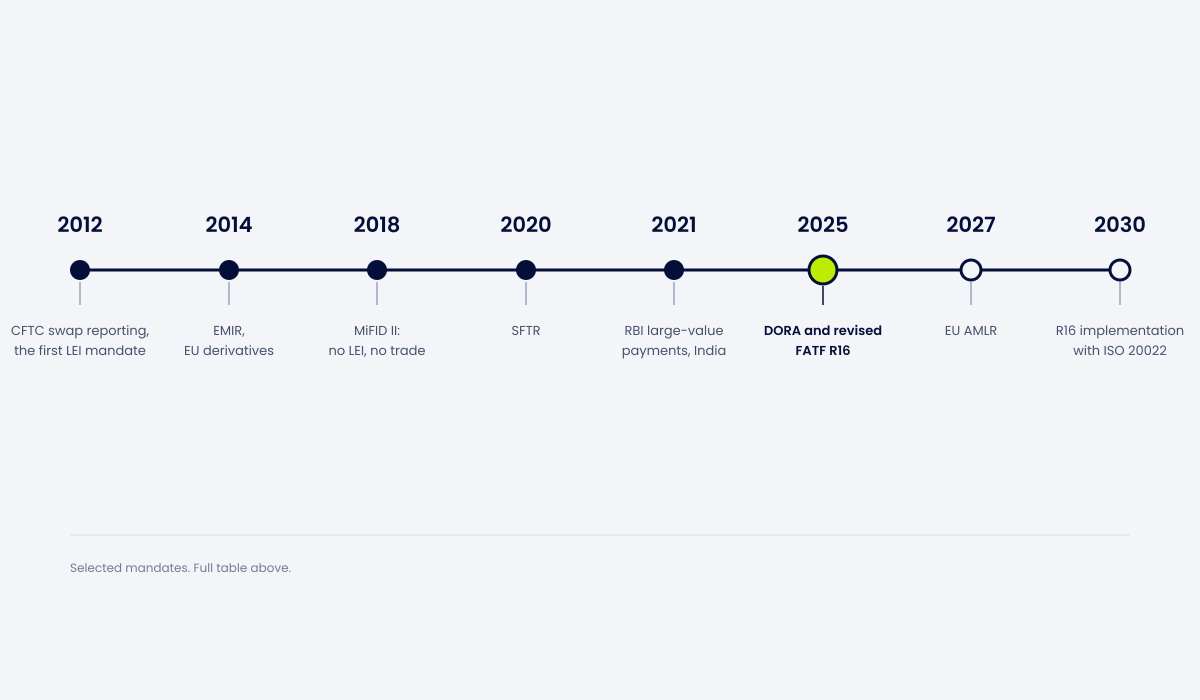
Frequently asked questions
Which regulations require an LEI?
Major regimes include MiFID II/MiFIR, EMIR and SFTR in the EU, UK MiFIR, CFTC and SEC reporting in the US, RBI mandates in India, DORA for ICT providers, and MiCA for crypto-asset firms. The searchable table on this page lists the requirements by jurisdiction.
Do I need an LEI to trade?
If you are a legal entity trading reportable instruments through an investment firm in the EU or UK, yes. MiFIR transaction reporting requires your LEI before the firm can execute: the rule known as no LEI, no trade.
Does my LEI need to be active or just registered?
Active. Most regimes, DORA explicitly, require a valid and active LEI. A lapsed LEI fails the requirement and must be renewed before it can be used for reporting.
Who sets LEI regulations?
Individual regulators write the rules, but the system itself is overseen by the LEI Regulatory Oversight Committee, more than 70 public authorities from over 50 jurisdictions, with GLEIF operating the Global LEI System under its oversight.
Sources
LEI Regulatory Oversight Committee, membership and charter — leiroc.org
FATF, The FATF Recommendations, Recommendation 16 and Interpretive Note as revised, payment transparency, 2025 — fatf-gafi.org (PDF)
GLEIF, regulatory use of the LEI and commentary on FATF Recommendation 16 — gleif.org
ESMA, EBA and EIOPA, Final Report on draft ITS on the Register of Information (JC 2023 85), January 2024 — esma.europa.eu
Reserve Bank of India, LEI notifications: OTC derivatives (2017), large-value payments (2021), cross-border transactions (2023) — rbi.org.in
CFTC Market Risk Advisory Committee, recommendations on Legal Entity Identifiers, December 2024.
Regulation (EU) 2022/2554 (DORA); Regulation (EU) 2023/1114 (MiCA); Regulation (EU) 2015/760 as amended (ELTIF).
Compiled and maintained by LEI Worldwide. Last reviewed August 2026.