
Commercial Partnerships
Our partnership programme offers flexible, customisable solutions to meet you and your client bases LEI needs.

Help Centre
Find the help and support you need for your LEI from our highly trained support staff
Our partnership programme offers flexible, customisable solutions to meet you and your client bases LEI needs.
Find the help and support you need for your LEI from our highly trained support staff
The united States is home to one of the most advanced financial regulatory frameworks in the world. The Legal Entity Identifier has become an integral part of the US financial system. Driving transparency, controlling risk and reducing exposure in a post 2008 Lehmann Bros financial system.
There are currently almost 1.7 million Legal Entity Identifiers (LEIs) in existence today. The United States has maintained the lions share of LEIs for the last ten years. There are roughly 220,00 LEIs registered in the USA, accounting for 13.2% of LEIs globally.
Since the last Global Financial Crisis in 2008, the Legal Entity Identifier has become an omnipresent feature of regulatory compliance within the global financial system. This is because there are innumerable benefits to having a single, global identifier for all legal entities which principally is stored on a public database of trusted, reliable and up to date data.
The United States and UK have been the primary drivers of the LEI globally, however the EU countries also have advanced regulatory frameworks and are proportionally represented in Fig 1.1.
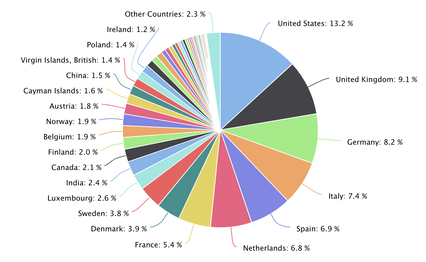
Fig 1.1 – Global Distribution of LEIs globally (GLEIF source)
The LEI is a G20 endorsed, globally verifiable unique identity code. The LEI code contains a record with information about a company such as its identity and group structure. The LEI system provides one centralized source of information, that contains vast amounts of attainable, high quality data.
The large volume of LEIs in the US is also not solely due to the fact that United States is home to the worlds largest economy and financial markets. But it is the fact that the LEI is highly regulated in America. Like Europe, the USA relies heavily on the LEI system to deliver transparency and manage risk exposure within their financial system.
Also similar to Europe, the USA has a litany of regulatory requirements where parties to a securities transaction or participants within a certain industry are required to identify themselves by way of a Legal Entity Identifier.
For example,The CEA (Commodity Exchange Act, 2012) includes the LEI in reports since 2012. The CEA and SEC are the biggest drivers of LEI regulation. But the Dodd-Frank Act also heavily requires LEI to be reported for certain transactions, along with The CFCT, NAIC, FED & Investment Advisors Act (IAA).
Most recently, being introduced in 2020 in the US is the FERC (Federal Energy regulatory Commission) and Form BE-10A which will both require the LEI for data collection and transparency purposes.

Below, you will find a list of requirements and regulations specific to the USA which mandate or request the use of an LEI. Please note, that the use of the LEI in America is not limited to this list. There are regulations existing in Europe and globally that may also require USA entities to comply by way of having an LEI.
The Commodity Exchange Act originally introduced in the 1930s, primarily regulates the sale and purchase of commodity futures in the US. New regulations are established by the CFTC (Commodity Futures Trading Commission). The CEA was updated following the 2008 crash to include LEIs in the following areas:
– CFTC Form TO
– CFTC Form 102 Identification of “Special Accounts”
– Ownership and Control Reports, Forms 102/102S, 40/40S, and 71; Final Rule
– CFR Parts 3, 32, and 33 Commodity Options
– Amendments to Swap Data Record keeping and Reporting Requirements for Cleared Swaps
– Proposed Amendments to the Swap Data Access Provisions of Part 49
Investment Advisors Act was founded in 1940 in order to standardise and monitor the activities of investment advisors. Administered by the Securities Exchange Commission (SEC) it is the principal regulatory reporting requirement for independent investment advisors. When reporting to the SEC in the following areas an LEI Code should be included to identify parties:
The central bank of the United States is the Federal Reserve. Founded in 1913 by the US Congress in an effort to create a more stable monetary system. The Federal Reserve have reporting requirements for market participants and an LEI must be included in the following reports:
– 17 CFR Part 242 Consolidated Audit Trail; Final Rule
– NSRO Filings (Nationally Recognized Statistical Rating Organization)
– (FORM N-MFP) Monthly Schedule Of Portfolio Holdings Of Money Market Funds
If you require an LEI, or would like to find out more about LEIs in the United States, please click the button below or begin your application:
The information on this page was procured from the GLEIF regulatory use of the LEI page.

Number 9 Pembroke Street Upper, Dublin 2, D02 KR83
18 Finsbury Square Alphabeta, London EC2A 1AH
S No 203/1 PL 1/4A B12 APPT, NR UY Patil College Cinchwadgoan, Chinchwad Mulshi Pune, Pune 411033, Maharashtra, India
Official partner and registration agent to ubisecure rapidlei
LEI Worldwide facilitate entity identification in the global financial system, capital markets and private sector. We make the process accessible and simple for Legal Entities to obtain Legal Entity Identifier numbers. By doing this we help facilitate the global allocation of LEI numbers. It is our mission to be the one point of contact globally between Legal Entities & LOU’s and ensuring the LEI becomes the Worlds most important identifier.
Awards



Supported By



Payment